







FloatLab


From top: Concept images provided by Höweler + Yoon Architecture and Brick Visual with Urban Engineers.
The river is never out of reach
A first-in-the-U.S. destination.
Designed by artist J. Meejin Yoon and Höweler + Yoon Architecture with Bartram’s Garden and Mural Arts Philadelphia, FloatLab is the country’s first tide-responsive experience.
Starting in 2027, visitors to Bartram’s Garden and the Bartram’s Mile section of the Schuylkill River Trail will enjoy a rare, water-level view of an urban river in motion. That’s thanks to FloatLab’s unique ballast system, which allows its circular platform to rise and fall with the rhythm of the Tidal Schuylkill River. Get ready to reconnect with the life-sustaining, beating heart of our city through hands-on workshops, outdoor art programs, kayaking, fishing, and other riverfront activities.
From top: Concept images provided by Höweler + Yoon Architecture and Brick Visual with Urban Engineers.
Frequently Asked Questions
About FloatLab
What is FloatLab?
Located on the Tidal Schuylkill River at Bartram’s Garden, FloatLab is a permanent, floating public space that blends ecology and art for a first-of-its-kind waterfront experience. FloatLab will open to the public in Spring 2027! Subscribe here for updates and early access to plan your visit.
Why create FloatLab?
Everyone should feel safe and welcome in nature, and that includes the river in Philadelphians’ own backyards. But did you know that FloatLab is only the second safe access point to the Tidal Schuylkill? As a world-class work of art that’s free and accessible to all, FloatLab offers a fun, innovative, and unusual experience for anyone seeking to connect with the waterway’s vibrant, ecological world.
FloatLab Team & Communities
Who created FloatLab?
FloatLab is a partnership between Bartram’s Garden and Mural Arts Philadelphia, designed by artist J. Meejin Yoon and Höweler + Yoon Architecture. Urban Engineers’ ports and waterways team worked with us behind the scenes to bring the project to life, with installation by Commerce Construction Corporation and fabrication by East Coast Steel Fabrication, Inc.
How are neighboring communities and populations involved in the project?
Bartram’s Garden works closely with Southwest Philadelphia neighbors to guide all campus investments and programming, and FloatLab is no exception! Resident leaders from the Southwest Philadelphia Community Leadership Team have advised on FloatLab’s progress since 2018.
Like all of Philadelphia, Bartram’s Garden is located in Lenapehoking, the homeland of the Lenape people. The riverfront near FloatLab is also the oldest excavated site in Philadelphia, with evidence of Native people relying on this waterway and the nearby tidal wetlands as early as 5,000 years ago—the river’s first caretakers.
The Garden’s Lenape Research Fellowship, guided by a paid Advisory Committee composed of citizens and friends of Native communities, seeks to recover and build a body of knowledge relating to Lenape Traditional Ecological Knowledge about this region. Our hope is that this work will inform improved care for the entire park, including the area surrounding FloatLab, and shape how the story of this land and river is told and retold. Learn more at bartramsgarden.org/lenape-history.
What is it like to be on FloatLab?
What can we do on FloatLab?
Everyone’s relationship to the river is unique—and FloatLab visits will be, too!
Explorers of all ages can get closer to the water than ever before and engage in activities like:
- Outdoor recreation, like fishing and birdwatching
- Hands-on environmental science activities, like water quality sampling and naturalist tours
- Art-making workshops and performances, curated with Mural Arts, neighbors, and local artists
- Classroom visits for young students, covering everything from environmental science to painting
And much more to come! Subscribe here to be notified when FloatLab ticket reservations open.
What is it like to be on FloatLab?
Visiting FloatLab is fun, safe, and like nothing else in the country.
A visitor to FloatLab will arrive on the access pier and cross the footbridge to the circular yellow surface. At first, this will feel like arriving on a standard dock: the surface will stay level with the water, even as the tide moves in and out.
From there, visitors descend around FloatLab’s ring-shaped ramp, gradually moving below the waterline until they can look directly at the surface of the water. All the while, they remain safe and dry inside FloatLab’s protective steel structure. As the tides move in and out, FloatLab’s underwater ballast chambers hold and release water, keeping the structure level with the shifting water.
The result is a thrilling view that you can’t see from other vessels—and we encourage everyone to experience it this fall!
When will FloatLab open to the public?
FloatLab will open to the public in Spring 2027 with experiences for locals and visitors of all ages. Click here to subscribe for early access to updates!
While Bartram’s Garden and Mural Arts Philadelphia hoped for a 2026 opening, Mother Nature had other plans, and conditions were not optimal for preparing FloatLab for public activation. FloatLab will provide unprecedented access to the river beginning in 2027, strengthening our collective relationship with the natural world—a critical step forward as we experience the effects of climate change. We look forward to welcoming visitors throughout the spring, summer, and fall who wish to learn, reflect, and connect with the Schuylkill River, the life-sustaining heart of our city.
Safety
Is FloatLab safe to visit?
Yes! Safety is the highest priority for FloatLab.
Everyone visiting FloatLab is fitted for a lifejacket prior to boarding, and a certified lifeguard is always on duty during FloatLab hours. In addition, staff will carefully monitor weather and river conditions for safety.
Despite the name, FloatLab is not at risk of floating away—it’s securely anchored to a series of mooring piles installed in the river. Its onboarding ramp is also suitable for wheelchairs, strollers, and other mobility assists, making it easier and safer for people of all ages and mobilities to come in close contact with the river.
Is FloatLab safe for the environment? It looks like it’s made of plastic.
FloatLab’s striking yellow color might remind you of plastic, but the 75-foot structure is actually constructed of industrial steel, built by a U.S. team that specializes in boats and barges.
We’ve worked for years with project collaborators to ensure that the structure will not disrupt the river’s ecosystems nor the aquatic creatures that call the river home. Furthermore, FloatLab won’t create any additional particulate, light, or sound pollution in the water.
.
Is the Schuylkill River safe?
Yes! Thousands of people each year already enjoy boating and fishing along this quiet stretch of river.
The health of the Tidal Schuylkill River has also improved significantly over the past 50 years, leading to a safer, healthier ecosystem for humans, plants, and animals. That’s good news, because the Schuylkill is home to a wealth of biodiversity, sustaining life for 200+ species of birds, 100+ species of plants, 50+ species of fish, and many aquatic animals. Some species have even returned in recent years—proof that the river’s water quality has improved!
That said, pollution and the area’s industrial heritage still have an impact on the Schuylkill’s health, and that’s why it’s crucial for all of us to deepen our relationship with the river. FloatLab is here to offer a free, equitable, and accessible entryway to learning about this vital, dynamic waterway.
Learn more about the river’s health and ongoing water quality monitoring at bartramsgarden.org/river.
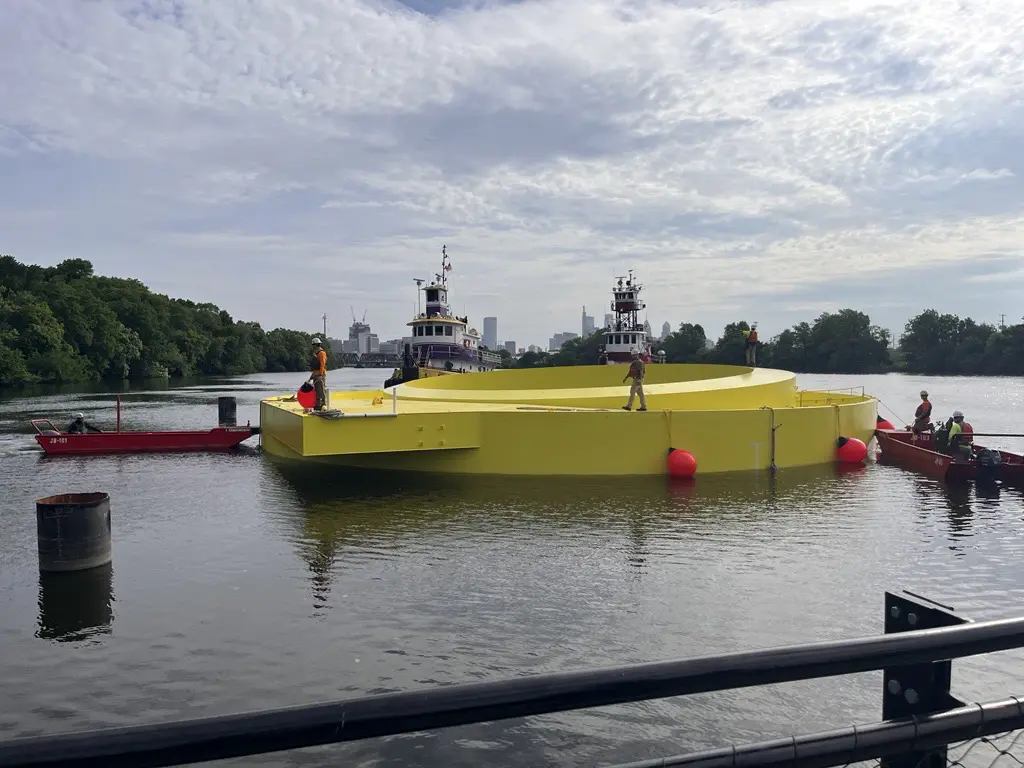
FloatLab’s arrival at Bartram’s Garden in June 2026.


From top: Eric Höweler and J. Meejin Yoon.
Inspiration image for FloatLab’s color: “Yellow patch (elm),” an installation by Andy Goldsworthy from November 1980. Goldsworthy described the work as “Leaf patches / edges made by finding leaves the same size / tearing one in two spitting underneath and pressing flat / on to another.” Image courtesy St Martin’s College, Lancaster, and the Andy Goldsworthy Digital Catalogue.
Designed by J. Meejin Yoon and Höweler + Yoon Architecture
Artist Statement
FloatLab is a platform, vessel, and lens that enables the public to experience the Schuylkill River and its ecology in a meaningful way. The project aims to create enhanced environmental awareness through an aesthetic experience of the water. By allowing visitors to directly engage with and re-imagine the river, FloatLab seeks to promote environmental stewardship. We believe public art that literally changes perspectives can create public awareness and shift collective consciousness around urban nature and environmental health to demonstrate how these systems are interrelated.
In physical form, FloatLab is a 75-foot-wide inhabitable floating steel ring. It is designed to accommodate the tidal water levels of the Schuylkill River, which see a 5–7 foot change daily, through a system of ballast chambers and mooring piles—not unlike a boat or pier. The structure frames the water both literally and figuratively and creates a new experience of the river by allowing a public promenade into the water to see, hear, and sense the river in a heightened and unfamiliar way. The circular form provides an accessible path that connects visitors directly with the river, while the sectional tilt offers an eye-level view of the water.
Functioning as a laboratory of sorts within the Schuylkill, FloatLab will be a venue for public activity and bring focus to the improvements of Philadelphia’s riverfront. Visitors will be able to experience a panoramic view of the 50-acre Bartram’s Garden, a designated National Historic Landmark, and the south Schuylkill River’s transforming industrial landscape. FloatLab’s chartreuse color, inspired by the autumn leaves at Bartram’s Garden, serves as a reminder of the continuing legacy of the oldest surviving botanical garden in North America and the capacity for the vibrancy of nature to focus our attention on the environment. Despite the damaging industrial history of the Schuylkill River, decades of ecological restoration beginning with what became the first Federal Superfund project in 1949, exemplify the opportunities of ecological restoration, but also the need for continued progress. FloatLab will be a landmark project for Philadelphia and will provide an important space for collective contemplation, experience and discussion that can catalyze a community-wide environmental consciousness.
We worked with naval engineer C.R. Cushing to develop the engineering and ballast system for FloatLab, which subdivides the circular form into 10 chambers beneath and adjacent to the walking surface. Similar to the ballast on ships, these chambers are filled with predetermined amounts of ballast water to lower FloatLab into the water in a balanced manner, with the outer edge of FloatLab sitting just 9” above the water. Before certain weather events and over the winter, this ballast water can also be removed from the chambers to limit water ingress. In the event that water from wakes or waves enters the walking area below the water surface, a drain at the bottom of the ramp will discharge water back into the river. Furthermore, in the event of a large ingress of water, the ballast chambers contain sufficient air (buoyancy) to keep FloatLab afloat until the water can be pumped out. FloatLab will only be open when staffed, and the team has worked closely with Bartram’s Garden so that FloatLab can be incorporated into their existing water programming and water safety protocols. The team developed a prototype in 2016 to review this process before proceeding with the project, and safety has continued to be a guiding principle as we develop this exciting and unique project.
How FloatLab Floats
FloatLab is a semi-submersible structure that floats using principles of equilibrium, displacement, and buoyance within the Tidal Schuylkill River.
The Tidal Schuylkill is the southernmost portion of the Schuylkill River, located south of the Fairmount Dam. A river that is tidal follows the same rhythms as the ocean, with tides going in and out twice every day. In the Tidal Schuylkill, the direction of the flow reverses about every 6 hours, and the water level fluctuates by 5 to 7 feet as the tide goes in and out, creating wetland and mudflats along the banks.
By holding and releasing water, FloatLab constantly calibrates to stay at the water level, allowing visitors to be closer to the water in a new way.
Pedestrian Surface
A sloping perimeter allows visitors to descend safely below the waterline.
When visitors arrive on FloatLab, it may feel like accessing a dock: at the landing, FloatLab’s highest point, visitors’ feet will be just above the level of the water. Moving around the circular ramp will bring visitors to eye-level with the river–while still remaining safe and dry within FloatLab.
Substructure for Ballasts
Internally, FloatLab is framed like a barge.
The substructure is the structural frame and enclosure beneath the deck. This is comprised of a steel angle frame, with supports along the sides, bottom, and top, to create and support the steel ballast chambers.
Ballast Chambers
Ballast chambers hold water to raise and lower FloatLab like a submarine.
A ballast chamber is a watertight space that can hold water, lowering a floating structure’s center of gravity. By filling chambers with precisely calibrated volumes of water, FloatLab sits level and balanced, maintaining at least nine inches of freeboard, or the distance between the waterline of the river and the “deck” of the platform. These chambers also have a mechanical pump that can add or remove water from FloatLab as needed.
Buoyancy Chamber
This reserve holds air, providing upward force.
The buoyancy chamber is a sealed space that holds air for reserve, or additional, buoyancy. This trapped air helps keep the platform stable if other chambers take on additional water, like during a storm, giving the pumps time to remove any unnecessary water.
Sponsors
Financial assistance provided by the Commonwealth of Pennsylvania, Honorable Josh Shapiro, Governor.
Support also provided by the William Penn Foundation; the City of Philadelphia: Cherelle Parker, Mayor, Jamie R. Gauthier, City Council 3rd District, Susan Slawson, Parks & Recreation Commissioner; the Philadelphia Housing Authority through the Department of Housing & Urban Development Choice Neighborhoods Initiative Planning and Action Grant program; The Albert M. Greenfield Foundation; the Institute of Museum and Library Services; the John S. and James L. Knight Foundation; the Hess Foundation; the 25th Century Foundation; the Another Light Foundation; Bank of America; the Kligerman Family; Elizabeth Sterling; the National Oceanic and Atmospheric Administration Coastal Zone Management; the National Endowment for the Arts; and HRP Impact Foundation.
Updated June 2026
Partner
Sponsorship Opportunities
Fundraising is ongoing to ensure FloatLab’s successful completion and sustainable programming as an inviting, free community asset. We look forward to discussing ways to showcase your sponsorship through naming opportunities and other benefits.
To learn more, contact Director of Development & Communications Caroline Winschel at cwinschel@bartramsgarden.org or 215 729 5281 x104.
You may also be interested in:

Community Boathouse and Public Dock
Join us at the Community Boathouse and Public Dock for free public fishing, boating, and learning on the Tidal Schuylkill River.

Tidal Schuylkill River
Learn more about the river’s history, ecology, and continuing health.
Ecosystems Education Center
New classrooms and learning facilities supporting more than 4,000 student visits annually.